New Steam IP
Biofuel Farm
The Clear Alternative
New Steam IP
Biofuel Farm
New Steam IP
Biofuel Farm
New Steam IP
Biofuel Farm

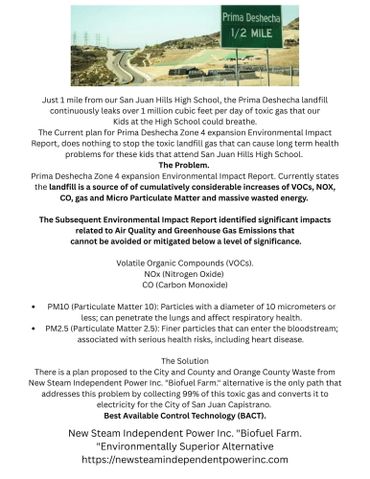
Just 1 mile from our San Juan Hills High School, the Prima Deshecha Landfill is wasting over 5.3 million cubic feet per day of methane gas. This could produce up to 30MW for 26,000 homes in South Orange County.
America's landfills continuously produce methane as organic waste decomposes. That gas is both an environmental-management challenge and an underutilized domestic energy resource.
NSIP proposes a different approach: transform the landfill from a passive waste-management liability into an integrated, continuously producing energy asset.
At Prima Deshecha, the NSIP Total Site Solution - Biofuel Farm would integrate advanced landfill-gas recovery, controlled biological processing, enclosed waste handling, distributed electricity generation, microgrid resiliency, and applied research within one site architecture.
NSIP proposes evaluating behind-the-meter AI/data-center application. Continuous landfill-derived generation may match high-density computing loads while reducing pressure on constrained transmission infrastructure.
1/10
Best Available Control Technology
"Aggressive Methane Management."
Project: NSIP Total Site Solution – The Biofuel Farm
Proponent: New Steam Independent Power Inc. (NSIP)
Objective. Transform regional waste streams into resilient, dispatchable waste-to-energy infrastructure, anchored by a 30 MW baseload design with a pathway toward 50 MW as feedstock and gas recovery are validated.
Footprint Strategy. Contain the project within existing operational boundaries, with no land encroachment proposed.
The Vision — A Global Carbon‑Negative Utility
Globally, there are 10,000+ methane‑producing landfills.
Worldwide potential:
3–5 PWh/year of carbon‑negative electricity
NSIP becomes the largest carbon‑negative energy producer.
PWh or petawatt-hour, a massive unit of energy equal to 1,000,000,000,000 kilowatt-hours (kWh)

"The Bio-Energy Research Lab turns the Prima Landfill into a living laboratory. We aren't just reacting to the waste we receive; we are actively engineering it to produce more power. This facility secures our position as a leader in the Best Available Control Technology and ensures that every ton of waste is squeezed for its maximum energy and carbon value. It moves Prima Deshecha from being a 'Toxic Gas Producer' to being the 'Silicon Valley of Bio-Energy'."


The Vision — A Global Carbon‑Negative Utility
Globally, there are 10,000+ methane‑producing landfills.
Worldwide potential:
3–5 PWh/year of carbon‑negative electricity
NSIP becomes the world’s largest carbon‑negative energy producer.
PWh stands for petawatt-hour, a massive unit of energy equal to 1,000,000,000,000 kilowatt-hours (kWh)

The Innovation: NSIP Biofuel Farm / Bioreactor.

https://www.yolocounty.gov/home/showpublisheddocument/75767/638077427014970000
Page 2
Landfill gas monitoring (Pilot scale project, Task 4): Over the past year, landfill gas monitoring has shown greatly accelerated methane generation, with a rate constant over fivefold that seen from conventional landfills.
This finding amply confirms the hoped for acceleration of methane generation and waste stabilization, with important implication for both increased renewable energy capture from landfill methane,
Best Available Control Technology

Unable to extinguish a smoldering chemical reaction that sent
noxious odors into area neighborhoods
We cannot allow Prima Deshecha to become the next Chiquita Canyon. While the County labels odors as 'unavoidable,' we see in Castaic that 'unavoidable' actually means 'uncontrollable.'
The NSIP Biofuel Farm is the only option that uses negative-pressure containment to ensure our community never suffers the health and financial crisis currently unfolding in North LA County.

Our Prima landfill here in San Juan Capistrano burns off 3000 scfm of LFG that could produce
25-30MW or more
This alone could power up to 20,000 homes or more in South Orange County now.
A total waste of this valuable consistent renewable energy.
Over 1 million scf per day escapes the uncontrolled landfill into local neighborhoods near the High School.

Over 2000 landfills nation wide have no LFG collection system at this time.
Only 542 have any kind of collection. And still waste millions of cubic feet of methane daily.
https://www.epa.gov/lmop/project-and-landfill-data-state

Consistent Renewable Energy
Our Biofuel Farm project aims to capture 100% of this valuable consistent renewable energy.
This will provide energy for Orange County for
decades to come. This form of landfill design and operation converts the landfill into a bioreactor.

The Clear Alternative
1/4
S U B S E Q U E N T
E N V I R O N M E N T A L
I M P A C T
R E P O R T
J A N U A R Y 2 0 2 6
https://oclandfills.com/sites/ocwr/files/2026-01/App%20C_Odor%20Study.pdf
Page 3
1.1.3 Landfilling and Potential Odor Activities
Landfill related odors may come from sources such as: potentially two working faces operating simultaneously (Zone 1 and Zone 4); leachate (i.e., water that has passed through the landfill layers); landfill gas (LFG) which is a natural byproduct of decomposing organic material; flares which burn any excess LFG collected by the Landfill; and Capistrano Greenery Composting Operation.
1.1.4
Odor Control Measures at the Landfill
The Landfill has developed and implemented an Odor Control Management Plan that includes measures such as:
Application of daily "dirt" cover.
LFG collection and control system.
Odor neutralizing misting system located on the ridge separating Zone 1 from the Rancho San Juan residential area.
Various portable misting systems.
Biosolids and green waste are deposited when not raining on weekdays prior to 11 am.
DRAFT REPORT OCWR PDL SEIR QOA http://www.scsengineers.com
Berm between Landfill and Rancho San Juan/Whispering Hills community provides a buffer.
Limit the width of the open working faces to the extent possible during odorous conditions.
Reject odorous loads, or apply odor neutralizer and cover immediately.
Monitoring weather reports and site conditions on an ongoing basis.
Neighbor Support Portal (NSP) that allows Landfill neighbors the ability to submit comments, questions, and concerns by using an online form.
Routing received complaints directly to all site staff for immediate response:
observe the area of concern for smell and neighborhood conditions.
inspect the active landfill and compost operations for any unusual activities or conditions, identify possible sources of odor; confirm implementation of applicable minimization measures, review working face sizes, weather conditions, biosolids, and importation status; and when possible, implement changes or remedial actions on the same day, such as covering certain parts of the working faces with tarps, increasing the use of deodorizer sprays, or pausing biosolids receipt and disposal.
In addition, OCWR is currently planning to expand into Zone 4 of the Landfill property. Zone 4 is located east of Avenida La Pata which gives OCWR the ability to conduct waste operations further away from the closest homes in Rancho San Juan during weather conditions that exacerbate odors. For example, the availability of Zone 4 makes it possible to operate split lifts putting public loads in Zone 1 while putting commercial loads, which are generally more odorous, in Zone 4. The development and use of Zone 4 will coincide approximately with the implementation of the Proposed Project to increase the daily maximum tonnage of waste accepted at the Landfill.
Page 1-9 Proposed Project would result in increased impacts, resulting in a cumulatively considerable net increase of VOCs, NOX, CO, PM10, and PM2.5.
PWh petawatt-hour, a massive unit of energy equal to 1,000,000,000,000 kilowatt-hours (kWh)
(ESA) Environmentally Superior Alternative
(RNG) Renewable Natural Gas
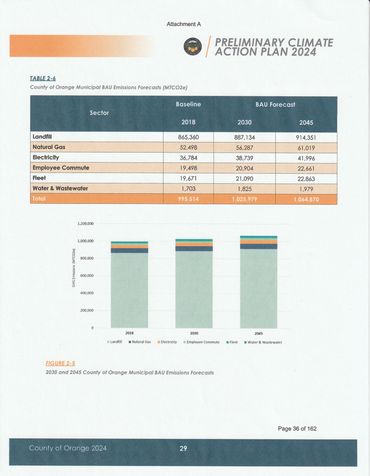
(BAU) Municipal Business-as-Usual
(EIR) Environmental Impact Report
(VOCs) volatile organic compounds
NOx (Nitrogen Oxide)
CEQA California Environmental Quality Act
CARB California Air Quality Board
California Energy Commission (CEC)
CARB (LMR) Landfill Methane Regulation
(ITC). Investment Tax Credit (ITC).
(LCFS) Low Carbon Fuel Standard Carbon Credits
(RECs) Renewable Energy Credits
(CapEx) Comprehensive Capital Investment
(OpEx) Operational Expenditures
MOU (Memorandum of Understanding)
(PPA) Power Purchase Agreement
(IRR):Internal Rate of Return
(TPD) tons per day dumped at landfill.
CEQA (California Environmental Quality Act)
LLDPE (Linear Low-Density Polyethylene)
"Carbon Negative"(-420 CI Score)
(CI) Carbon Intensity
Leachate (toxic trash juice) rain run off.
NOx (Nitrogen Oxide)
(siloxanes and H_2S) impurities
siloxanes (silica-based contaminants)
CARB California Air Quality Board
(LMR)Landfill Methane Regulation
(ACP) Alternative Compliance Plan".
(VOCs) volatile organic compounds ).
(POI) Point of Interconnection
(SGIP) Self-Generation Incentive Program funds from the state.
(IRA) Inflation Reduction Act
Section 48E provides a 40% direct cash payment for
renewable energy projects like this
(BACT) Best Available Control Technology
Final CAP mandate for "Aggressive Methane Management.